
Most marketers think they understand pricing psychology.
They add .99 to prices.
Run a sale.
Maybe throw in a “limited time” badge.
Call it a day.
But that’s surface-level stuff.
If you want to win in 2026, you need to understand how people actually evaluate value, because buyers don’t calculate — they feel, compare, and shortcut.
And those shortcuts follow patterns.
How the Brain Really Evaluates Value
1. The Decoy Effect
In 1982, researchers Joel Huber, John Payne, and Christopher Puto showed how adding a bad option can radically change decisions. Later, Dan Ariely demonstrated this with The Economist subscription pricing.
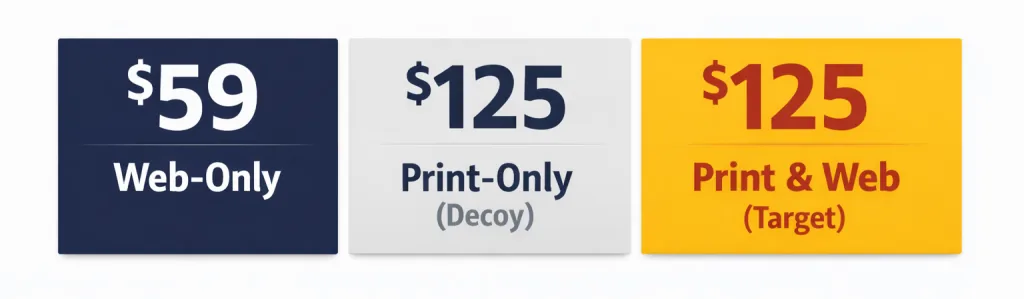
When all three subscription options were shown, 84% chose the premium option.
Remove the middle “decoy”, and only 32% chose it.
Nothing about the product changed.
The comparison did.
What this means for marketers:
You don’t persuade by pushing harder. You persuade by shaping comparisons.
Add a third option nobody really wants.
Make your target offer look obvious by contrast.
2. Loss Aversion Beats Gain Every Time
In 1979, Daniel Kahneman and Amos Tversky developed Prospect Theory. One key insight:
Losses feel roughly twice as painful as equivalent gains feel good.
That’s why Adobe doesn’t say:
“Upgrade to get more features.”
They say:
“Your trial ends today. You’ll lose access.”

Same outcome.
Very different motivation.
What this means for marketers:
Frame what people stand to lose, not what they might gain.
3. Framing Changes Decisions (Even When Facts Don’t)
Tversky and Kahneman also showed that identical information, framed differently, leads to opposite decisions.
-
72% chose an option framed as “saves 200 lives”
-
Only 22% chose the same option when framed as “400 people will die”
Same numbers.
Same outcome.
Different emotional response.
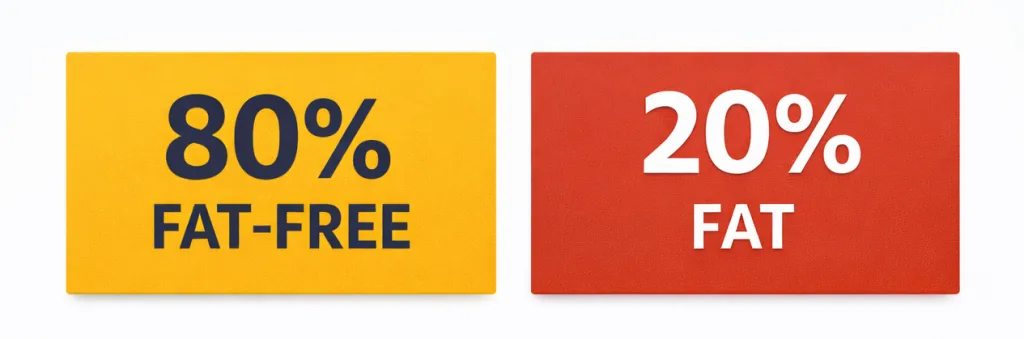
It’s why “80% fat-free” outperforms “20% fat” — even though they’re identical.
**What this means for marketers:
**Facts don’t persuade.
Interpretation does.
4. Anchoring Sets the Entire Game
The first price someone sees becomes their reference point.
Show a $10,000 watch first and the $2,000 option feels reasonable.
Start at $2,000 and suddenly everything else feels expensive.
Nothing changed except the anchor.
**What this means for marketers:
**You’re not just setting prices — you’re setting expectations.
Control the first number people see.
5. The Halo Effect Multiplies Perceived Value
Back in 1920, psychologist Edward Thorndike identified the Halo Effect:
one strong positive trait causes people to assume everything else is good too.
Apple is the textbook example.
They design beautiful products — so people assume:
-
the ecosystem is better
-
the security is tighter
-
the service is superior
One strength radiates across everything.
What this means for marketers:
You don’t need to be great at everything.
You need to be undeniable at one thing.

Why This Actually Matters for Growth
Your audience isn’t irrational.
They’re efficient.
Their brains take shortcuts because attention is scarce.
These principles guide those shortcuts.
If your pricing, offers, and positioning ignore how decisions are really made, you’re fighting biology.
If you design with it, conversion feels effortless.
The Strategic Takeaways
-
Use decoys to make your target offer feel obvious
-
Frame outcomes as loss, not gain
-
Control the first anchor people see
-
Build one undeniable strength that casts a halo over everything else
That’s understanding how humans decide.
And in 2026, that’s table stakes.