When a business is investing serious money into paid search, the conversation should move beyond keywords and cost-per-click.
At enterprise level, paid search is no longer about simply “running campaigns”. It is about systematically finding incremental gains that compound into significant revenue growth.
If your organisation is allocating a substantial budget to Google Ads or Microsoft Ads, there are a handful of fundamentals your paid search specialist should be actively managing. Not occasionally. Consistently.
Here are five areas that should never be neglected.
1. Microsoft Ads (Bing) Should Always Be Running
Many enterprise advertisers overlook Microsoft Ads because the traffic volume is smaller than Google.
That is a mistake.
Microsoft Ads often delivers some of the highest-intent and highest-converting traffic in the entire search ecosystem.
The audience skews slightly older and tends to include users who are less likely to comparison shop across multiple suppliers. When they search, they are often ready to act.
For many advertisers, Microsoft Ads can represent only 5–15% of total search volume, but frequently delivers stronger conversion rates and lower cost per acquisition.
If your paid search team is not actively managing Microsoft Ads alongside Google, you are likely leaving profitable conversions on the table.

2. Image Assets Should Be Used Everywhere Possible
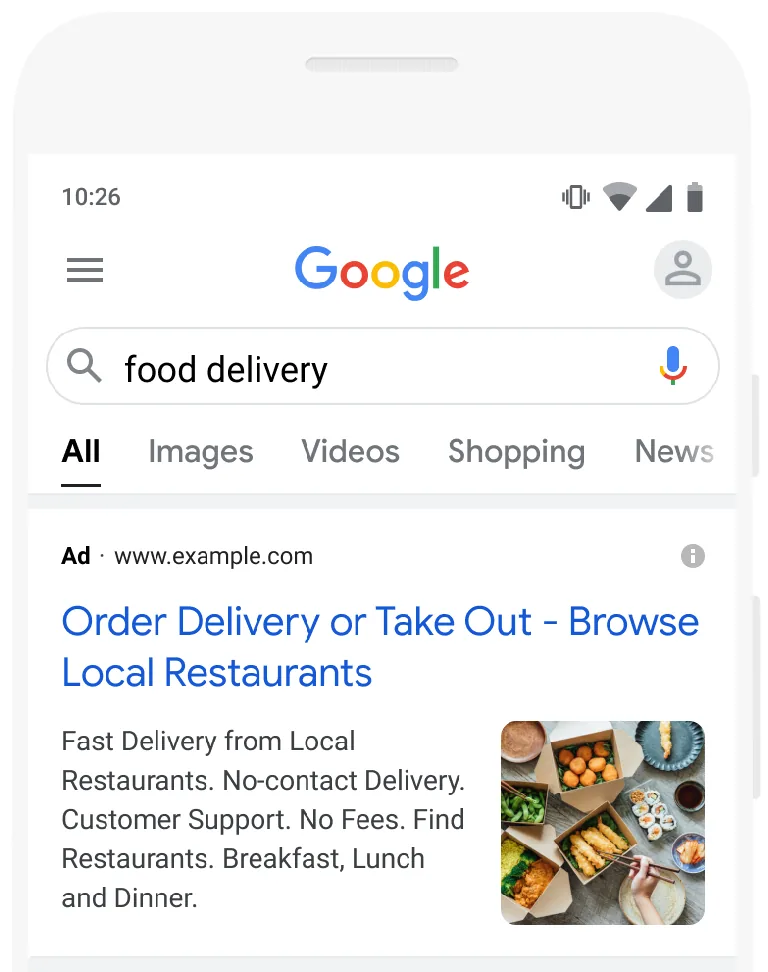
Search ads are becoming increasingly visual.
Image assets allow advertisers to include product or brand imagery alongside standard text ads, giving your ad a much stronger presence on the results page.
When your ad appears in position one, image assets can dramatically increase the visual footprint of the ad and improve click-through rates.
For enterprise advertisers competing in crowded auctions, that additional visibility can make the difference between winning and losing the click.
If your campaigns are not making full use of image assets, it is a missed opportunity.
3. Sitelinks Should Drive Users to Specific Intent
Sitelinks are often treated as a box-ticking exercise.
They shouldn’t be.
Well-structured sitelinks help capture different layers of intent within the same search.
For example, someone searching for a broad product category may actually be looking for:
- A specific product
- Pricing information
- A comparison guide
- A demo or consultation
Sitelinks allow you to address those needs directly within the ad itself.
When used properly, they expand the size of the ad, improve click-through rate, and direct users to the most relevant page for their intent.

4. Ads Should Be Tested Constantly
One of the biggest performance levers in paid search is also one of the most commonly ignored.
Ad testing.
A strong structure is to run three Responsive Search Ads (RSAs) per ad group, allowing the platform to test different messaging combinations.
But testing is not a “set and forget” exercise.
New ads should be introduced regularly so that messaging evolves alongside:
- market conditions
- seasonal trends
- competitor positioning
- customer concerns
As a general rule, ads should be refreshed every 6–12 weeks, depending on traffic volume.
Without continuous testing, performance stagnates.

5. Landing Page Testing Is Where the Real Gains Live
Most paid search teams obsess over keywords and bids.
The highest returns often come from somewhere else entirely.
Landing pages.
Small improvements in conversion rate compound quickly at enterprise scale.
A 1–2% improvement in conversion rate may sound small, but if you run multiple tests each year those gains stack up rapidly.
Three to five successful landing page tests in a year can materially change the economics of a campaign.
Importantly, these tests do not have to be complicated.
In one campaign we worked on, a simple change to the hero image on the landing page generated an additional $2.1 million in revenue.
That is the power of incremental optimisation.

The Bottom Line
Large paid search budgets demand more than just campaign management.
They require systematic optimisation across every lever available:
- expanding profitable channels like Microsoft Ads
- maximising ad visibility through assets
- continuously testing messaging
- improving landing page conversion rates
Individually, these changes may seem incremental.
Collectively, they drive the performance improvements that separate average paid search programs from exceptional ones.
And when enterprise budgets are involved, those incremental gains can translate into millions in additional revenue.